
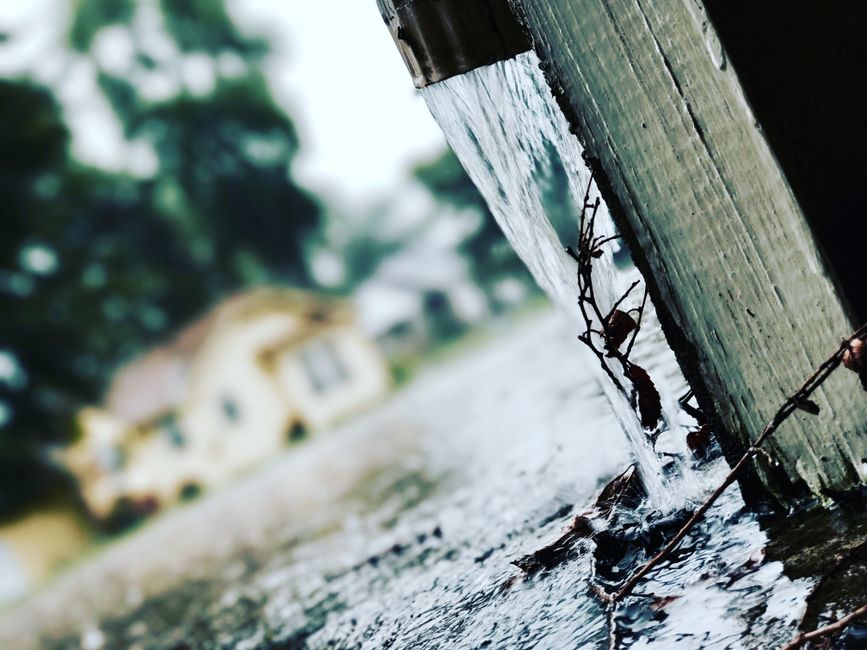
Right now matters. Fall brings bigger, more frequent storms across the Greater Houston area and standing water in a low corner of your yard will rot roots, invite mosquitoes, and lift pavers within a single wet season if you let it. Fixing drainage before the rains starts saves money and prevents plant loss.
Quick seasonal checklist: what to do before fall rains
- Clear gutters and downspouts (DIY). Clogged gutters spill along the eave line and dump concentrated flows into beds. Run a ladder, clear debris, and aim downspouts at least 4–6 feet away from the slab or grade to keep water off foundations.
- Check grading near slab edges (Pro advised if extensive). Soil should slope away from foundations at roughly 2% (about a quarter-inch per foot) for the first 6–10 feet. If you have less than that or visible pooling after a heavy shower, regrading or a small berm will help. Regrading a 200–400 sq ft yard corner typically runs $12–$25 per sq ft—access and existing irrigation raise the cost.
- Install a French drain along problem lines (Pro for parts, DIY for simple runs). A French drain is a perforated pipe in a trench wrapped with fabric and stone; it moves groundwater away from a wet spot. For a typical 50-foot run expect $25–$60 per linear foot nationally depending on depth and rock. This works well where clay holds water within the sod's root zone.
- Add a shallow retention bed or rain garden (DIY or Pro). A planted shallow depression—6–12 inches deep—captures roof and yard runoff and lets it soak in slowly. Use native, moisture-tolerant plants like Muhly grass, Muhlenbergia capillaris, or southern wax myrtle. Cost varies: DIY plantings for a 100 sq ft bed can be $150–$600 in materials; professional installs often start around $600–$1,500 with grading and soil amendment.
- Check irrigation overlap and run times (DIY). Overwatering compounds fall problems. Run each zone 1–2 times per week in fall, with 0.5–1.0 inch per watering for most zones and adjust per zone using a catch-can test. Fix spray overlap gaps and replace heads that mist—small fixes that cut soggy spots without heavy construction. See our irrigation checklist for season-specific steps in Houston: What to Do With Your Irrigation System as Houston Heads Into Fall.
Lower-cost fixes first (do these this month)
Start with gutters, downspout extensions, and irrigation tuning. These are low disruption and typically under $300 in parts if you buy extenders, splash blocks, and replacement sprinkler heads. In Houston clay, moving roof runoff just 4–6 feet can be the difference between a dry rootball and a dying shrub the following spring.
Medium-cost, moderate-disruption options
Regrading a yard corner, adding surface swales, or installing a shallow retention bed are the next steps. Expect $1,000–$5,000 for small zone regrades or planted retention beds in Houston's suburban lots—cost depends on how much soil we bring in, how compacted the subgrade is, and whether existing irrigation or utilities need rerouting. These fixes also reduce erosive sheet flow during heavy fall storms.
Heavier construction: when to hire a pro
Long French drains, deep detention trenches, concrete or paver channels, and any work within 5 feet of a foundation should be handled by a licensed contractor. Deep trenches need proper bedding and backfill, plus protected downspout connections. Expect national averages of $25–$100 per linear foot for longer subsurface drains and $15–$40 per sq ft for engineered surface channeling—narrow access and rock hauling push prices up. Also consider property-specific factors: Houston's clay shrinks and swells, and heavy equipment can compact your yard unless the crew stages properly.
Tie drainage fixes to Houston's conditions
Houston sees clay soils, high summer humidity, and concentrated fall rain events. That means two things: grade and sub-surface drainage matter more than surface mulch or topsoil, and plant choices matter in retention beds. Use St. Augustine or Zoysia for lawns where you need quick cover; avoid Bermuda in shaded, poorly drained spots. For planted swales choose switchgrass (Panicum virgatum), Muhlenbergia, or 'Natchez' crape myrtle where a woody root helps fast uptake. Also, watch downspouts during hurricane-season rains—rapid concentrated runoff is the usual cause of localized yard floods, not slow seepage.
For turf alternatives in chronically wet zones, artificial turf with proper base and perimeter drainage can be an option—learn more about our installation approach here: Artificial Turf Installation in Houston.
One thing to do first
If you do nothing else, extend and redirect your downspouts so water leaves the foundation footprint. It costs under $100 for basic extenders or splash blocks and you can see results after the next heavy rain. After that, prioritize irrigation tuning and then call a pro to evaluate low spots that still hold water.