
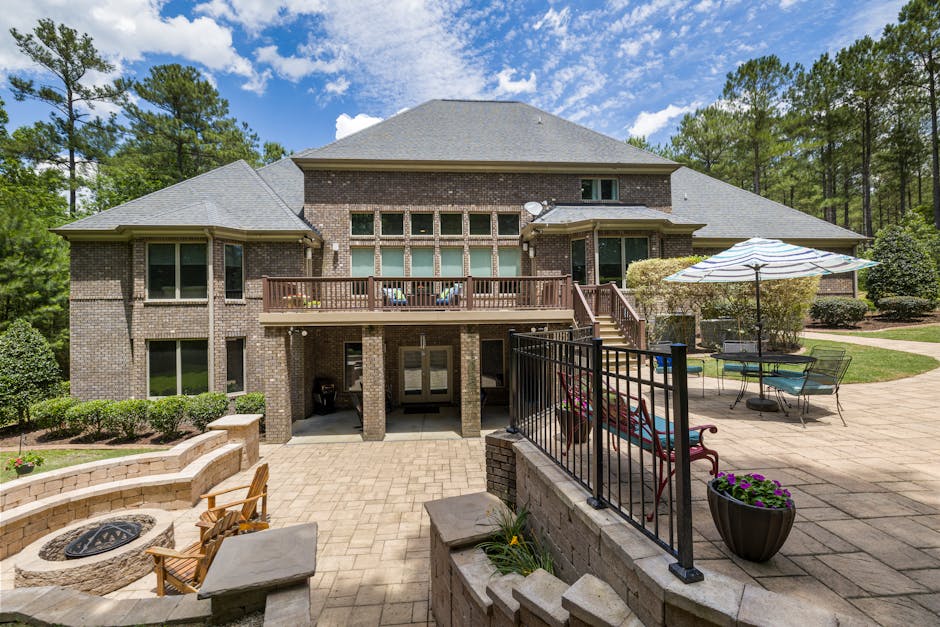
If you plan to be in the house more than five years and you want the surface to still look right in year ten, build a paver patio. Poured concrete makes sense when you need a big, cheap, utilitarian slab fast—a side pad, a shed floor, a driveway apron you don't look at—and you've accepted that it will crack somewhere on Houston clay.
That's the short version. Now the reasoning, because you're spending real money and you should understand what you're buying.
The soil is the whole argument
Most of the Greater Houston area sits on expansive clay—Beaumont and Lake Charles clays through much of Harris and Fort Bend, with sandier pockets north toward Montgomery County. That clay swells when it's wet and shrinks when it's dry. In a normal year we swing from spring rains that dump several inches in a weekend to an August stretch where the ground pulls back from the foundation and you can drop a pencil in the gap.
Movement of an inch or more across a season is common. A concrete slab is one rigid plate. When the ground under one corner drops and the other corner holds, the plate has two options: bend or break. Concrete doesn't bend.
A paver patio is not one plate. It's a few hundred small units sitting on compacted crushed base and a bedding layer of coarse sand, locked at the perimeter with edge restraint and locked internally by joint sand friction. When the clay moves, the field moves with it in small increments. You get a gentle roll instead of a crack. That's the whole trick.
Upfront cost: concrete wins, and it isn't close
Nationally, a broom-finish concrete patio typically runs about $8 to $15 per square foot installed. Stamped or colored concrete pushes that to roughly $15 to $25. Interlocking concrete pavers usually land in the $18 to $32 per square foot range, and natural stone or large-format porcelain on a proper base can run $30 to $50.
On a 400-square-foot patio, that's roughly $4,000 for plain concrete against $8,000 or more for pavers. Real difference. Local quotes vary with access, grading, and material, so treat those as national ranges rather than a bid.
What drives the paver number up is mostly labor and what's underneath. In clay we excavate deeper than most homeowners expect—typically 8 to 10 inches for a patio, more if it takes vehicle traffic—then bring in crushed base and compact it in lifts of about 3 to 4 inches at a time with a plate compactor. A single 8-inch dump of base compacted once is a job that fails in three summers. It looks identical on install day. That's the problem with base work: you can't see whether it was done right until the second wet spring.
Access matters too. If a wheelbarrow is the only way into the backyard because of a narrow gate or a pool, add labor. A skid steer path adds efficiency and subtracts from your bid.
Lifetime cost: the numbers flip around year eight
Concrete cracks. Not always, not everywhere, but plan on it. Control joints are cut to encourage cracking in a straight line, which helps the look but doesn't stop movement. Once a slab on clay cracks and the two sides settle at different rates, you have a trip edge and no good fix. Slab jacking or polyurethane foam lifting runs roughly $600 to $2,000 for a section, and it buys you time, not a solution—the clay is going to move again. Full replacement means demolition and haul-off, typically $2 to $6 per square foot before you pay for the new surface.
Pavers get repaired, not replaced. Lift the affected pavers by hand, correct the base, re-screed the bedding sand, set the same stones back. Half a day, a few hundred dollars, no color mismatch because you're reusing the original material. Most manufacturers stock the same profiles for years, so replacing a cracked or stained unit is a matter of pulling one and setting one.
Run it out twenty years. Concrete at $4,000 plus one repair and one partial replacement gets close to paver money, and you lived with the crack the whole time. Pavers at $8,000 plus periodic joint sand and one or two small resets stay ahead on appearance every single year.
Durability and maintenance, side by side
Here's the honest comparison on the points that come up on site visits:
- Load capacity: Interlocking pavers typically test at 8,000 psi or higher per unit. Residential concrete is usually poured at 3,000 to 4,000 psi. The paver system is stronger per square inch and it distributes load through the base rather than spanning it.
- Cracking: Concrete cracks as a plate. Pavers crack individually, if at all, and a single unit swaps out in minutes.
- Traction: Textured pavers hold grip when wet. Smooth-troweled or stamped-and-sealed concrete gets slick, which matters around a pool during our humid stretch when the surface rarely dries fully.
- Heat: Light-colored pavers and permeable joints run noticeably cooler underfoot than dark stamped concrete in July. Choose a lighter buff or gray if the patio is unshaded.
- Water: Permeable paver systems let rain pass through the joints into an open-graded base instead of sheeting toward the house. On a lot that already ponds, that's a drainage tool, not just a surface.
- Maintenance: Pavers need joint sand topped up every three to five years and polymeric sand reapplied when it starts to wash out at the low edge. Concrete needs sealing every two to three years if it's stamped or stained, and there's no fix for a crack once it opens.
- Stains: Grease from the grill, rust from a chair leg, tannin from live oak leaves—on pavers you replace the unit. On concrete you live with it or resurface.
One more thing about roots. Live oaks and water oaks are everywhere in older Houston neighborhoods, and their surface roots will eventually push whatever you put over them. A slab heaves and cracks. Pavers ride up, and when you're ready, you pull the section, prune or route around the root, and reset. Same stones.
Drainage decides more of this than either material does
Neither surface survives standing water. If your yard holds a puddle for two days after a storm, fix that before you spend a dollar on the patio. Water saturating the subgrade under a slab is what causes the differential settling that cracks it, and water trapped under a paver base is what causes soft spots and dips.
Practically, that means grading the patio away from the house at about a quarter inch of fall per foot, routing downspouts out and away instead of dumping them at the slab edge, and running a French drain or catch basin where the low corner needs it. Budget roughly $1,500 to $5,000 for meaningful drainage work on a typical residential lot, depending on trench length and whether there's a good discharge point.
Grading and drain tie-ins are not DIY weekend work. Trenching near a foundation, hitting an irrigation main, or discharging onto a neighbor's property all cause bigger problems than the one you started with. Topping off joint sand and pulling weeds out of the joints is DIY. Moving water is not.
Which one to build
Choose poured concrete if the surface is functional rather than featured—an AC pad, a walkway behind the garage, a slab under a storage building—or if you're preparing to sell within a year or two and need coverage at the lowest cost per square foot. Choose it if the budget genuinely won't stretch, because a well-poured slab beats a paver patio installed over four inches of uncompacted base.
Choose pavers if this patio is part of the view from the kitchen window. Choose them if you're building an outdoor kitchen, a fire feature, or a seating area that will hold furniture and get used year-round, because you'll want the ability to open the surface later for a gas line, a conduit run, or a root. Choose them if your lot has active clay movement, mature oaks, or a history of standing water. And choose them if you intend to stay, since the repair path stays open for the life of the patio instead of ending at demolition.
If you're unsure which situation you're in, walk your yard after the next hard rain and see where the water sits. That's the answer, usually. We'll come look at it with you and tell you straight—consultations don't cost anything.