
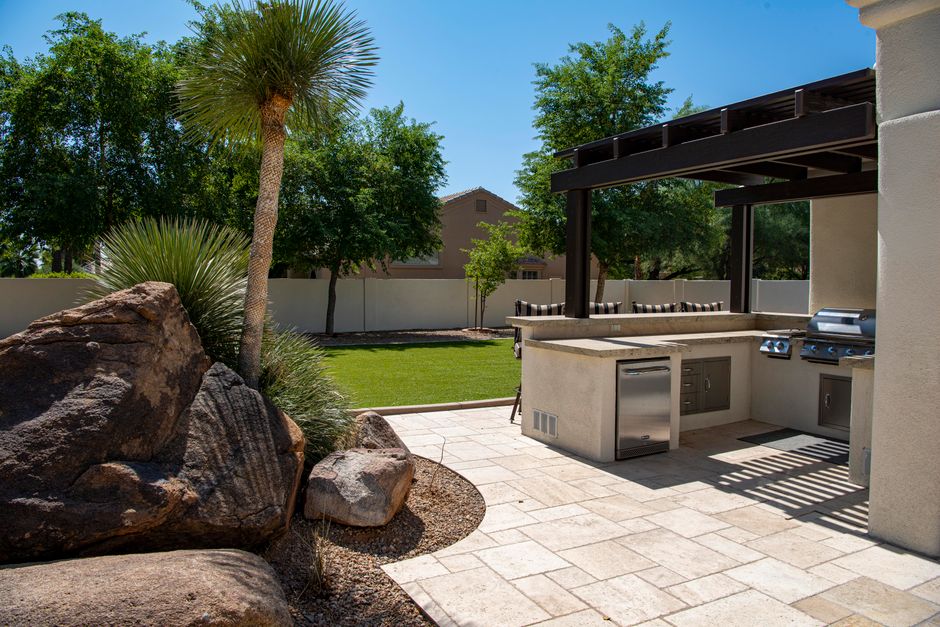
If you want to cook outside on Thanksgiving, September is when the work starts. Not October. A typical outdoor kitchen installation in Houston runs four to eight weeks from signed plan to first burner, and that clock doesn't start until the design is settled, the materials are ordered, and the permit questions are answered. Stone and appliance lead times stretch in the fall because everyone else has the same idea.
Call in mid-October and you're building through the first cold front, in the rain, with a slab that needs cure time. Call in September and the concrete is poured before Halloween.
Why fall is the season this project is actually built for
Houston summers run 95 degrees and 70 percent humidity into late September. Nobody stands over a built-in grill in August. The usable window here is roughly October through May, which is eight months of real use—longer than most of the country gets. That's the argument for spending the money in the first place.
It's also the better window to build in. Crushed base compacts more predictably when it isn't soaked, and mortar and polymeric sand set better below 90 degrees. Summer afternoon storms in Houston can put a hardscape crew three days behind in one week. Fall gives you drier ground and steadier working days.
The September checklist
- Settle where the kitchen goes, and how far it is from the house. Every foot of distance from the panel and the gas meter adds cost. Gas, water, and electric runs typically add $1,500 to $5,000 depending on trenching distance and whether you're cutting through an existing patio. Walk it, stake it, and stand there at 6 p.m. to see where the sun lands. DIY.
- Check drainage before you commit to the footprint. Houston clay doesn't absorb; it holds. If that corner of the yard puddles after a hard rain, a slab there will trap water against the house. Watch the yard during the next real storm and mark where water sits for more than an hour. Grading and downspout rerouting are pro work—get a laser level and a truck on it, not a shovel.
- Decide on counters and cladding early, because lead time drives the schedule. Granite and quartzite handle Gulf Coast humidity and UV better than most engineered surfaces, which can discolor in direct sun. Porcelain pavers and natural stone veneer are common cladding choices. Fabrication and delivery on stone tops often runs three to five weeks alone. Pro.
- Pick your appliances now, not after the frame is built. Built-in grills, side burners, drop-in coolers, and pizza ovens all have different cutout dimensions, and the frame gets built to those numbers. Order 304 stainless steel for anything living outdoors here—lower grades pit in salt-carrying Gulf air within a few seasons. Ordering is DIY; the framing that follows is not.
- Handle gas and electrical with a licensed trade. A natural gas line to a built-in grill and a GFCI circuit for a fridge are not weekend items. This is where permits and inspections come in, and where insurance questions show up later if it wasn't done to code. Pro, no exceptions.
- Plan lighting and shade in the same drawing. Task lighting over the cook surface and low-voltage path lighting to the back door change how often the space actually gets used after 6 p.m., and it's dark by 5:30 in December. Running low-voltage wire during the build costs almost nothing. Adding it after you've set stone means cutting stone.
- Adjust irrigation heads before the slab goes down. A new patio changes your spray pattern and your runoff. Capping or moving two heads takes an hour before construction and a repair call afterward. Head adjustment is DIY; anything touching the backflow preventer needs a licensed irrigator in Texas.
What it costs, honestly
Nationally, a modest L-shaped outdoor kitchen with a built-in grill, counter space, and stone cladding typically lands between $10,000 and $25,000. Add a pizza oven, a full bar run, a covered structure, or a long utility trench and you're into $30,000 to $60,000 and up. Per square foot, the built structure usually runs $150 to $400 depending on counter material and appliance package.
What drives the number isn't the grill. It's access, grading, and utility distance. A backyard with a narrow gate that won't fit a skid steer means material gets moved by wheelbarrow, and that labor shows up on the estimate. Local quotes vary, so get the site walked before anyone gives you a number.
The part nobody sees
Under a Houston outdoor kitchen, the base matters more than the finish. Clay soil moves with moisture—it swells in a wet spring and shrinks in an August drought, and that movement is what cracks slabs and separates veneer from block. The fix is excavation deeper than feels necessary, crushed base compacted in lifts of a few inches at a time, and a reinforced slab under the framing.
Skip that and you'll be looking at a hairline crack through your counter joint by year three. The stone on top is the cheapest part of the decision.
If you only do one thing this month
Stand in the backyard after the next heavy rain and find out where water goes. Everything else on this list can be reordered. That one can't. If the low spot is where you wanted the kitchen, you either move the kitchen or fix the grade first—and finding that out in September costs you a conversation. Finding it out in November costs you the patio.