
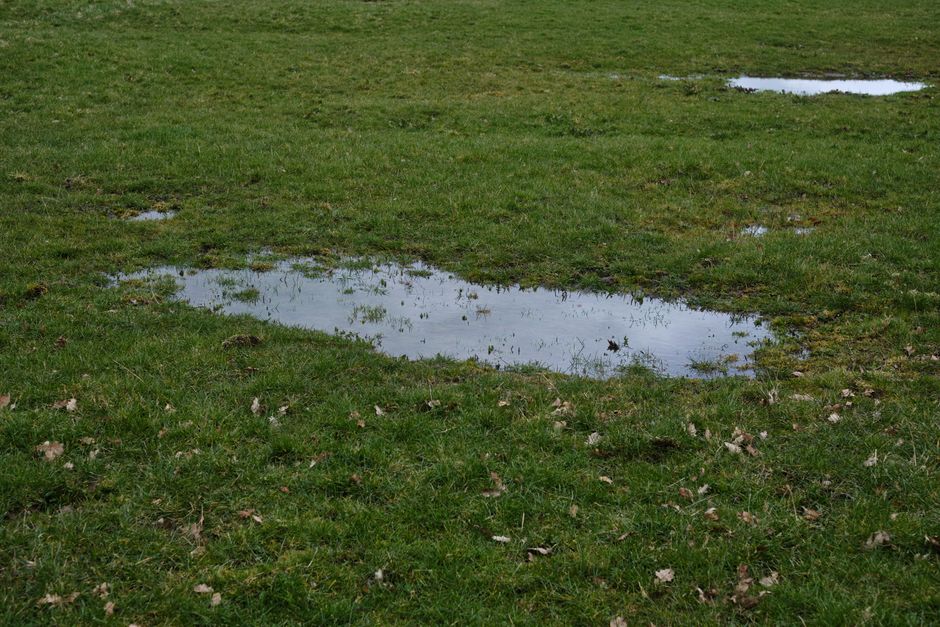
The ground under your yard is about to change. From late September into December, Houston gets the tail of hurricane season stacked on top of frontal rain, and our clay soil stops absorbing long before the rain stops falling. Gumbo clay swells shut. Water that used to soak in starts running, and it runs wherever your grading tells it to.
Here's the concrete consequence of ignoring that. Two inches of standing water against a foundation or a paver patio for 48 hours is enough to start the cycle — saturated base, soft subgrade, then settling you can measure with a level by spring. St. Augustine sitting in water for three or four days goes yellow and thins out, and take-all root rot moves into the bare spots. Fixing all that in March costs several times what a fall drainage correction costs in September.
Walk the Yard During the Next Real Rain
Not after. During. Put on boots and go out while it's coming down hard, and watch where water actually moves. You're looking for three things: where it pools, where it sheets toward the house, and where it leaves the property. Take photos with your phone. A puddle that's still there 24 hours after the rain stops is a low spot that needs regrading, not a puddle.
Most Houston lots were graded once, at build, and then a decade of settling, flower bed additions, and new fence posts rerouted everything. That's normal. You just need to know the current map before you spend money.
The Fall Drainage Checklist
Work through these in order. The first four are cheap. The last three usually aren't, but they're the ones that protect the expensive parts of your property.
- Clear gutters and check downspout discharge. A 2,000 square foot roof sheds roughly 1,250 gallons in a one-inch rain. If your downspout dumps two feet from the slab, all of that lands against your foundation. Extend discharge at least 6 to 10 feet away, farther if the ground slopes back toward the house. DIY.
- Pull mulch back off the trunks and off the slab. Mulch volcanoes piled against a trunk hold moisture and rot bark, and mulch mounded against the foundation traps water where you least want it. Keep mulch two to three inches deep and pull it back a few inches from anything woody. DIY, and free.
- Check that beds aren't higher than the lawn. Every time you top-dress a bed you raise its grade. After a few years the bed is a dam and the lawn behind it is a bathtub. Either lower the bed or add an outlet. DIY for small beds, pro if it means moving edging or retaining walls.
- Shut down or dial back the irrigation schedule. Established St. Augustine needs about an inch of water a week total, and October and November rain often covers all of it. Running zones on a summer schedule into a wet fall is how you get soggy soil and fungus. Add a rain sensor if the controller doesn't have one. DIY for scheduling, pro for anything at the backflow preventer — that's licensed work in Texas.
- Inspect existing area drains and catch basins. Pop the grates. Pine needles, crepe myrtle blossoms, and silt clog them fast, and a blocked catch basin is worse than no catch basin because it holds water at the low point. Flush the line with a hose and see if it comes out the other end. DIY to inspect, pro if the line is collapsed or root-invaded.
- Look hard at the patio and walkway edges. Pavers creeping outward, gaps opening at the joints, or one corner sitting lower than the rest means water is undermining the base. Catch it now, before the wet season makes it worse. Relaying a section is far cheaper than rebuilding the field. Pro. This is base work, not surface work.
- Address any low spot that holds water more than 24 hours. Depending on the situation, that's regrading, a French drain, a dry creek bed, or a catch basin tied to a solid line running to the street or a suitable outlet. Pro. Grading requires equipment and a real understanding of where the water is going next.
What Drainage Work Actually Costs
Nationally, a French drain typically runs $30 to $80 per linear foot installed, depending on depth, whether it's a trench through open lawn or one that has to thread past tree roots and irrigation lines, and how far the outlet is. Surface catch basins tied into a solid PVC line usually land in the same range. Regrading a yard section commonly falls between $1.50 and $4 per square foot, driven mostly by access — if a skid steer can't get through the gate, everything moves by wheelbarrow and the labor doubles.
Houston adds its own multiplier. Clay is heavy, trenches want to hold water, and many neighborhoods have restrictions on where you can discharge. Local quotes vary, so get the scope in writing: depth, pipe type, outlet location.
Drainage Before Decoration
People call in the fall wanting new sod, a fresh bed line, or a patio extension. Fair enough. But if water sits in that spot for two days after every storm, none of it lasts. Sod rots. Bed soil washes out. Patio base softens and the stone settles unevenly. Water has to have somewhere to go before you spend a dollar on what sits on top. That's the whole trick.
If You Only Do One Thing
Extend your downspouts. Today, before the next front. Roof runoff is the single largest volume of water hitting your property, it's concentrated at four or five points, and it's the easiest thing on this list to fix. A 10-foot extension and a splash block move more water away from your foundation than anything else you can do for under fifty dollars.
Then, next time it rains hard, go stand in the yard and watch. If you see water heading toward the house or pooling where it shouldn't, get eyes on it before the ground saturates for the season. A consultation doesn't cost anything, and September problems are a lot smaller than March problems.